

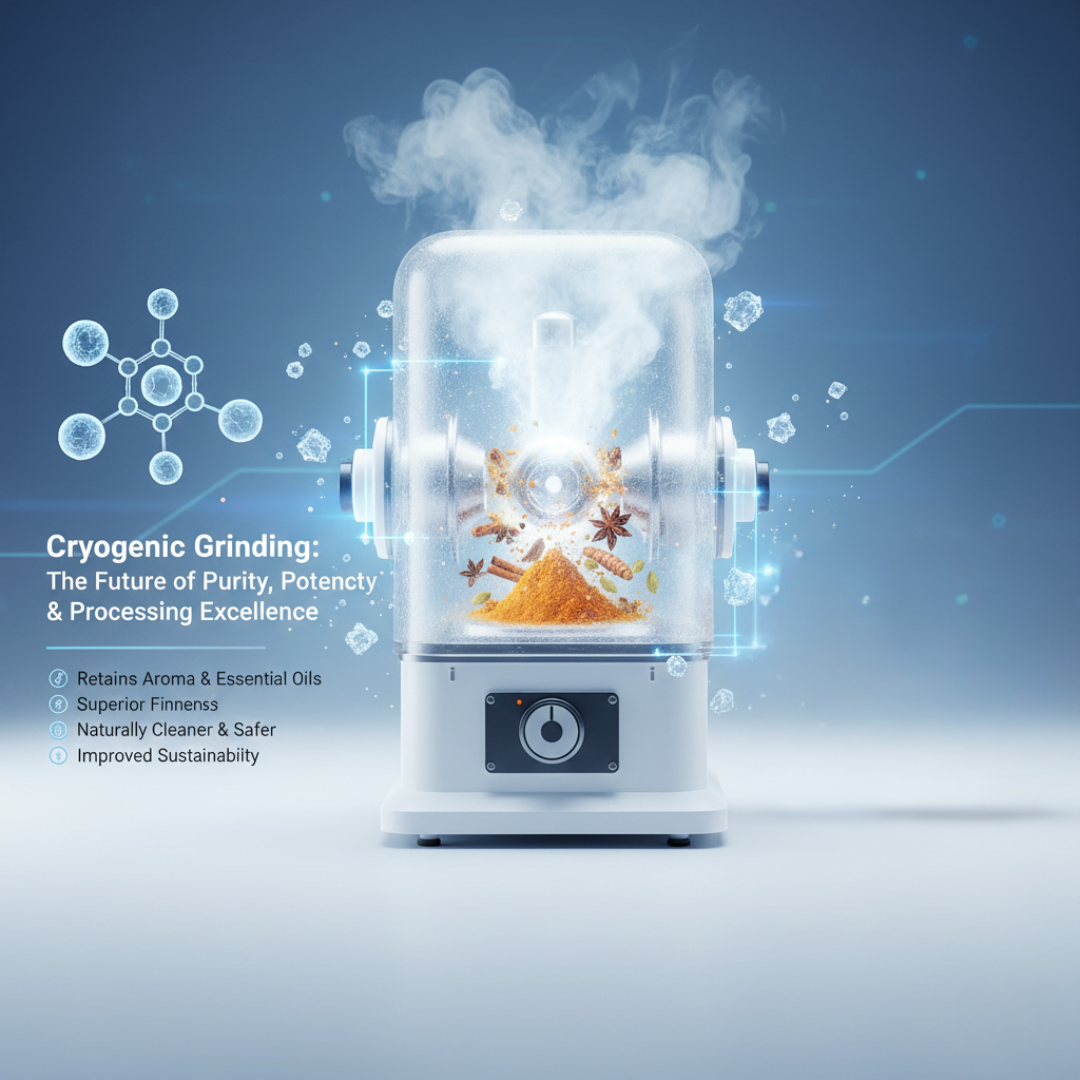
In a market where consumers are becoming increasingly conscious about purity, freshness, and authenticity, the food and spice industry is undergoing a quiet but powerful transformation. Among the most impactful innovations leading this change is cryogenic grinding — a technique that uses extremely low temperatures, typically with liquid nitrogen, to grind spices while preserving their natural integrity.
Traditional grinding has been the backbone of spice processing for decades, but the heat generated during the process often compromises essential qualities like flavour, aroma, colour, and nutrient profile. Cryogenic grinding solves these challenges and sets a new benchmark for quality.
What Is Cryogenic Grinding?
Cryogenic grinding involves cooling spices to very low temperatures (up to -196°C) before grinding. This ultra-cold environment makes spices brittle and significantly reduces heat generation during milling, resulting in a cleaner, more efficient process.
Why Cryogenic Grinding Is a Game Changer
1. Retention of Aroma & Essential Oils
Spices owe their fragrance and functional properties to essential oils. In conventional grinding, heat causes these oils to evaporate, resulting in a loss of flavour and potency.
Cryogenic grinding keeps temperatures low, locking in the natural aromatic compounds and ensuring the spice stays fresh, vibrant, and true to its original profile.
2. Superior Fineness & Consistency
The extreme cold makes spices more brittle and easier to break down. This produces a fine, uniform powder that enhances solubility and improves performance in food formulations, nutraceuticals, and ready-to-cook products.
3. Naturally Cleaner & Safer
Cryogenic temperatures inhibit microbial activity and minimize contamination risks. This leads to a cleaner, safer product with a longer shelf life — without applying irradiation or excessive heat.
4. Enhanced Colour & Visual Appeal
Heat oxidation during traditional grinding often dulls the natural colour of spices. Since cryogenic grinding eliminates heat, spices retain their original bright, appealing colours, which is especially beneficial for premium food products.
5. Improved Sustainability & Efficiency
Although the process uses liquid nitrogen, it is far more energy-efficient than conventional grinding. Reduced product loss, higher output, and better retention of quality make it a sustainable choice for modern manufacturers.
Relevance to Today’s Clean-Label Expectations
Consumers today expect transparency, minimal processing, and natural integrity in the products they buy. Cryogenic grinding aligns perfectly with this shift by:
-
preserving natural nutrients
-
ensuring minimal heat intervention
-
avoiding chemical preservatives
-
improving raw material integrity
For brands that prioritise purity and authentic flavour, adopting cryogenic grinding isn’t just a technological upgrade — it’s a statement of commitment to quality and consumer trust.
The Road Ahead
As the demand for premium spices, functional ingredients, and clean-label products continues to rise, cryogenic grinding is poised to become the industry standard. Manufacturers who adopt this technology today position themselves ahead of the curve — delivering products that maintain nature’s essence with unmatched precision.
Cryogenic grinding embodies the future of spice processing: smarter, cleaner, more efficient, and uncompromising in quality.


